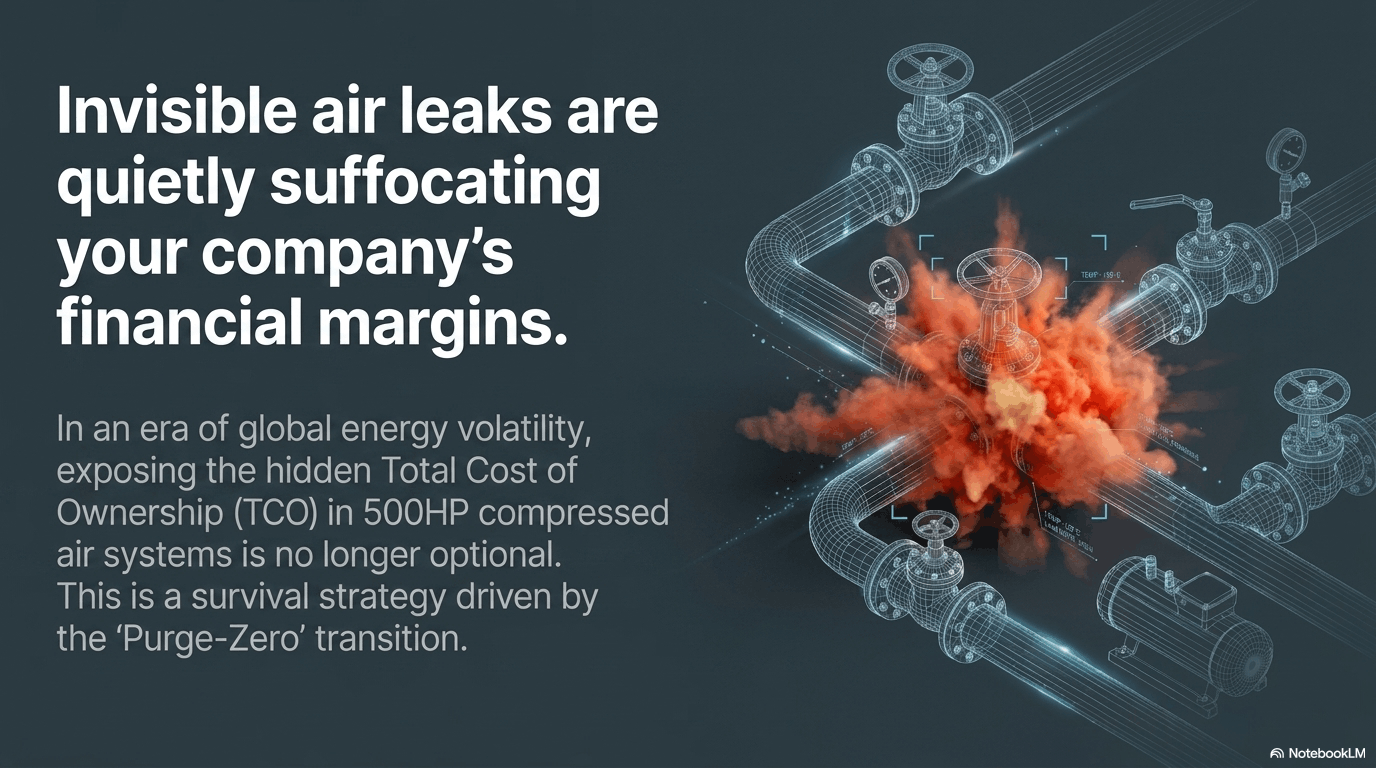
Invisible air leaks are quitely suffocating your company's financial margins
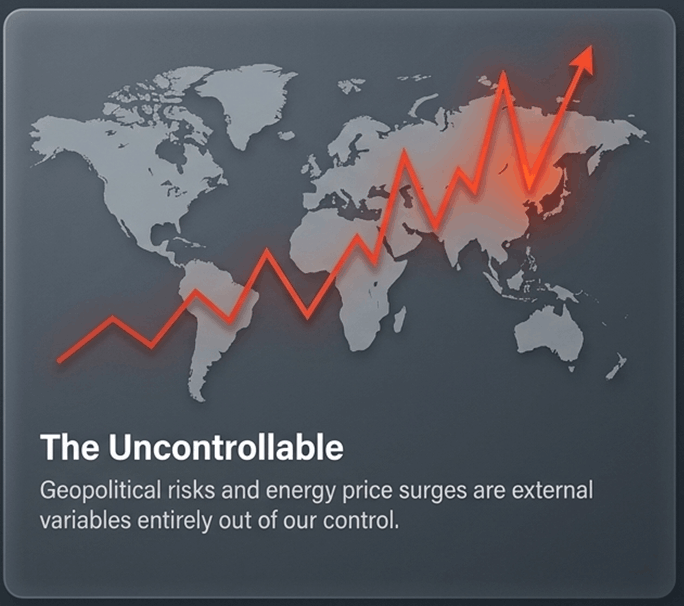
Global upward trend line graph showing geopolitical risks and skyrocketing energy costs

Global energy markets are more unstable than they have been in years. Rising geopolitical tensions in the Middle East — driven by the escalating US-Iran conflict and growing concerns over a potential blockade of the Strait of Hormuz, through which a significant share of the world’s crude oil flows — are sending energy prices into turmoil across global markets.

This goes well beyond a temporary economic slowdown. Soaring energy costs have become a direct threat to the survival of manufacturing businesses worldwide. In an environment where losing cost competitiveness means being pushed out of the market, energy saving is no longer optional — it is an essential survival strategy.

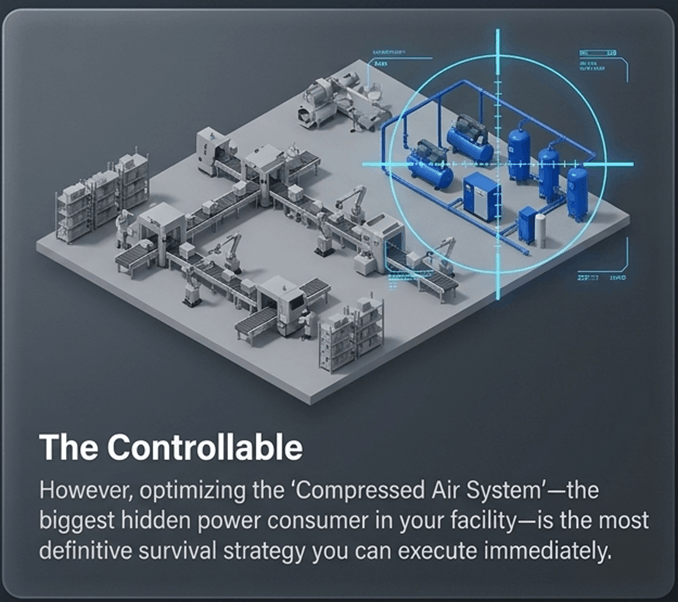
Optimizing the Compressed Air System - the biggest hidden power consumer in your facility-is the most definitive survival strategy you can execute immediately

So where is energy being silently wasted the most inside your facility? The answer is your compressed air system — the air compressor and dryer combined.

In this article, we present economic analysis data from a 500HP-class desiccant air dryer to demonstrate, with clear facts and figures, exactly why switching to a blower non-purge (ZEHB) dryer is the most cost-effective decision your facility can make right now.

Comparing 3 Desiccant Air Dryer Regeneration Types: PEH, PEHB, and ZEHB

Emphasis on the leakage of compressed air painstakingly produced for adsorbent regeneration in the piping
Desiccant air dryers remove moisture from compressed air through a process of desiccant regeneration. Depending on the regeneration method used, energy consumption and maintenance costs vary dramatically.
Heater Purge (PEH)
A portion of the dried compressed air is diverted and heated through an internal heater to regenerate the desiccant. This method generates excessive purge loss.
Blower Purge (PEHB)
Ambient air is drawn in by an external blower, heated, and used for regeneration. This reduces purge loss compared to the heater purge method.
Blower Non-Purge (ZEHB)
No compressed air is used during the regeneration cooling phase. Purge loss is 0% — completely eliminated.

Key Comparison Data: Purge Rate and Annual Compressed Air Loss (500HP Baseline)

Conditions: 500HP · 24hr/365days · 3,415 Nm³/hr · Dew Point -40℃ · Electricity KRW 190/kWh

The Purge-Zero strategy completely eliminates
a 73.6 million KRW annual systemic leak.

Heater Purge
(PEH)

Purge Rate: 10.7%

Daily Loss: 8,770 Nm³

Annual Financial Loss:
~ 73.62 Million KRW

Blower Purge
(PEHB)

Purge Rate: 5.7%

Daily Loss: 4,672 Nm³

Annual Financial Loss:
~39.21 Million KRW

Blower Non-Purge
(ZEHB)

Purge Rate: 0% (zero)

Daily Loss: 0 Nm³

Annual Financial Loss:
0 KRW

Blower Non-Purge (ZEHB) is the only zero-loss (0%) solution that uses absolutely zero purge air during cooling and regeneration.

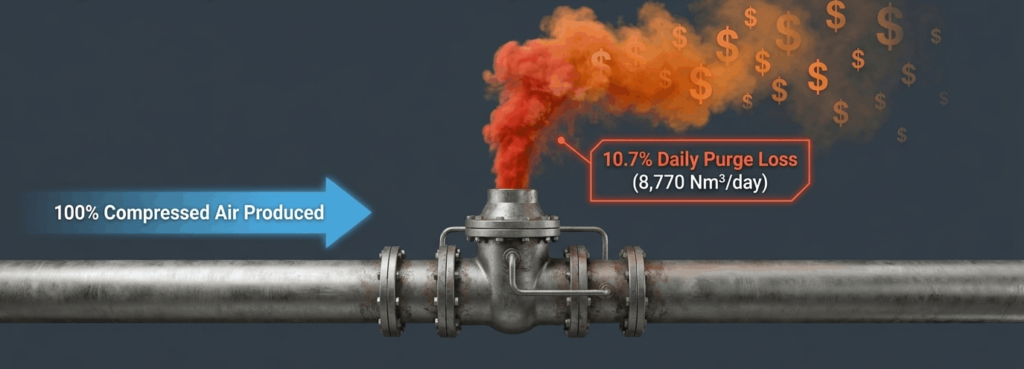
Every day, 10.7% of the compressed air generated by
your expensive electricity evaporates into thin air.

Infographic showing that 10.7% of the generated compressed air evaporates when using the PEH heater purge model

Traditional Heater Purge (PEH) systems siphon off processed, expensive compressed air just to regenerate
their desiccants. In an era where energy is weaponized, this is identical to evaporating your operating profit.

💡 Expert Insight: Does this surprise you? If your facility is running a heater purge (PEH) desiccant air dryer, 10.7% of every cubic meter of compressed air you produce — at significant electricity cost — is being vented into the atmosphere solely for desiccant regeneration. The resulting annual compressed air loss alone exceeds KRW 73.6 million. At a time when energy has become a strategic resource, this is the equivalent of letting your operating profit evaporate into thin air.

Heater Purge vs. Blower Non-Purge: Total Cost of Ownership (TCO) Compared

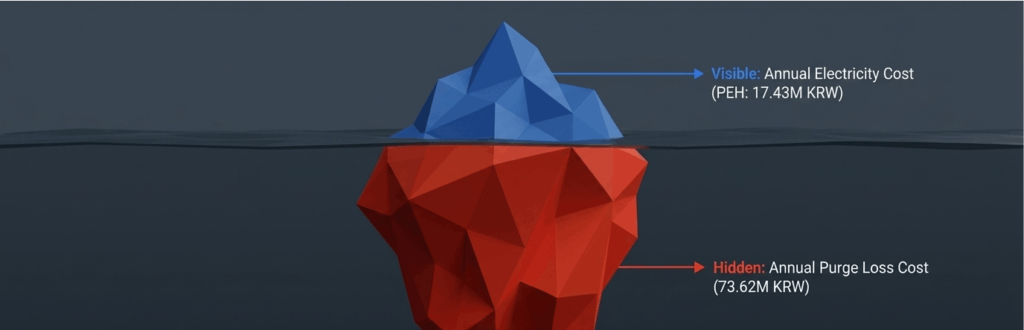
Evaluating equipment based on 'power consumption'
is merely looking at the tip of the iceberg.

Iceberg infographic: visible annual electricity cost (PEH: 17.43M KRW) above water vs. hidden annual purge loss cost (73.62M KRW) below — the hidden cost is over 4 times greater
Because of its blower motor, the ZEHB model appears to consume more electricity on paper. But the moment you uncover the massive 'hidden cost' of compressed air purge loss, your entire criteria for decision-making must change.

Judging by rated power consumption alone, the ZEHB blower non-purge dryer may appear to consume more electricity — due to its higher motor capacity. However, once compressed air loss costs (purge loss) are factored into the total annual operating cost, the Total Cost of Ownership (TCO) tells a completely different story.

When we calculate Total Cost of Ownership (TCO),
the financial reality completely reverses.

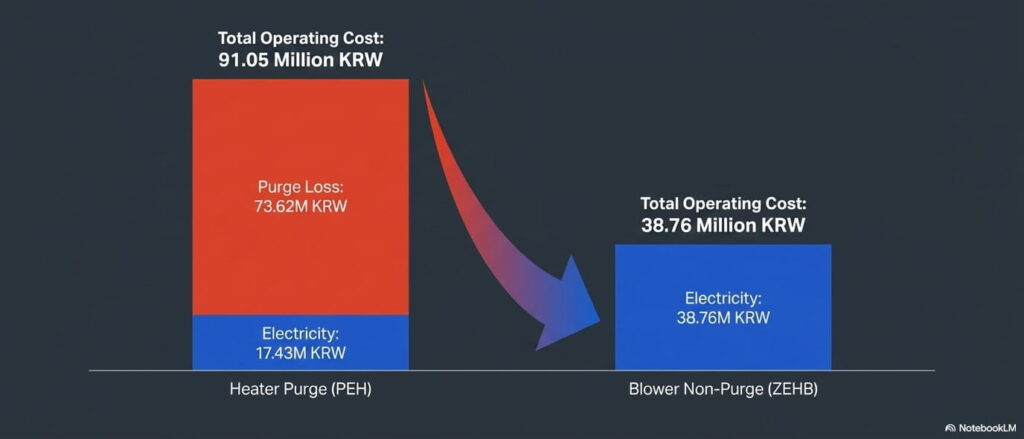
Bar chart comparing total operating costs: Heater Purge (PEH) at 91.05M KRW (electricity 17.43M + purge loss 73.62M) vs. Blower Non-Purge (ZEHB) at 38.76M KRW (electricity only) — ZEHB reduces total cost by 57%
Despite higher initial power ratings, the actual total annual operating cost of the ZEHB is overwhelmingly lower.

The annual operating cost of the heater purge (PEH) model reaches approximately KRW 91.05 million, while the blower non-purge (ZEHB) model can be operated at approximately KRW 38.76 million.

Why the ZEHB Initial Investment Is Fully Recovered Within 1 to 2 Years

The psychological barrier of CapEx translates into
pure, perpetual Net Profit within 24 months.

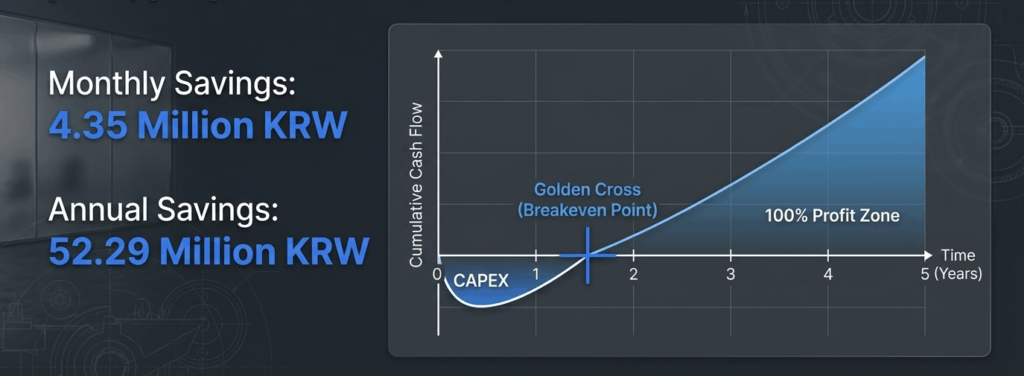
A chart explaining the inflection point where the monthly savings of 4.35 million won and annual savings of 52.29 million won resulting from the introduction of the Blow Non-Purge ZEHB Adsorption Dryer turn into profit between one and two years.
The equipment price differential is recovered 100% within 1-2 years.
Every dollar saved thereafter flows directly to your bottom line.
Based on our data analysis, the following results are achieved when upgrading from a standard heater purge (PEH) dryer to the Blower Non-Purge (ZEHB) series:
  • Monthly Savings: Approximately KRW 4.35 million
  • Annual Savings: Approximately KRW 52.29 million
“Concerned about the upfront cost?” The ZEHB type carries a higher initial purchase price than the PEH type. However, when annual operating savings of over KRW 52 million are taken into account, the price difference between the two units is fully recovered within 1 to 2 years. From that point forward, every KRW saved converts directly into net profit for your business.

GSA ZEHB Blower Non-Purge Desiccant Air Dryer: Begin Your Energy Savings

Installed GSA Compressed Air System equipment

Crises in the Strait of Hormuz and fluctuations in global oil prices are external variables beyond any manufacturer’s control. However, eliminating energy waste within your facility and maximizing production efficiency is the most reliable survival strategy — one that is entirely within your control, starting today.
The most direct and proven path to converting wasted energy into business profit is clear.

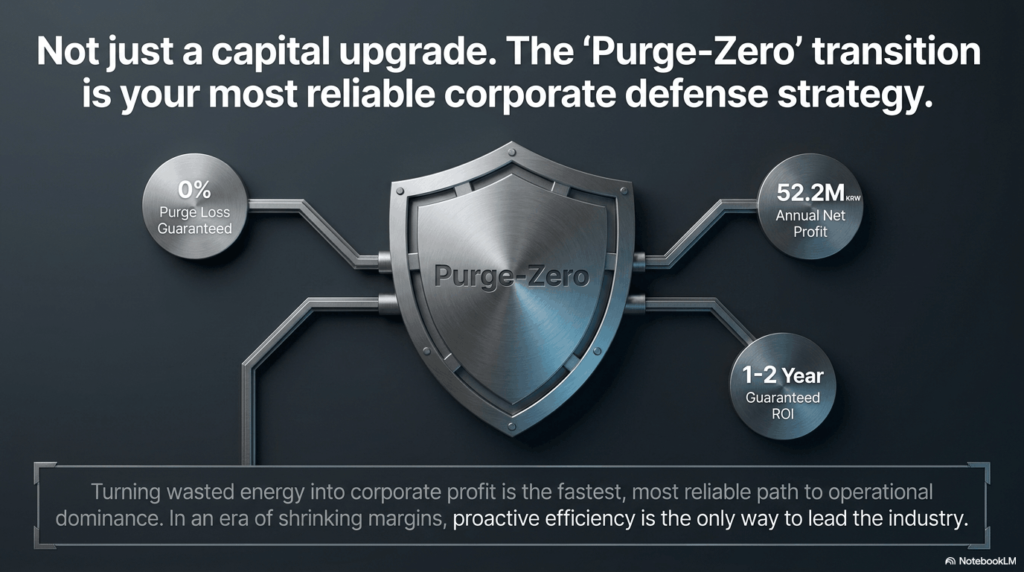
The ZEHB blower non-purge desiccant air dryer — the only solution that achieves true Purge-Zero — is that answer. Only manufacturers who respond proactively to market volatility will be positioned to lead their industry through the challenges ahead.
For a detailed solution consultation tailored to improving your facility’s cost competitiveness, contact GSA – Global Standard Air/Gas at any time.

There are three main regeneration methods: Heater Purge (PEH), Blower Purge (PEHB), and Blower Non-Purge (ZEHB). Each method differs in the energy source used for desiccant regeneration and whether compressed air is consumed during the process, resulting in significant differences in energy consumption and total operating costs.
The ZEHB method uses zero compressed air during the regeneration cooling phase, achieving a purge loss rate of 0%. Unlike the heater purge (PEH) method, which consumes 10.7% of compressed air output for regeneration, the ZEHB dryer delivers 100% of produced compressed air directly to the production process.

Under 500HP operating conditions, the annual operating cost of a heater purge (PEH) desiccant air dryer reaches approximately KRW 91.05 million. Of this, compressed air purge loss alone accounts for approximately KRW 73.62 million per year — the majority of total operating costs.
The ZEHB dryer’s rated power consumption may appear higher due to its blower motor. However, when compressed air purge loss costs are included in the Total Cost of Ownership (TCO), the ZEHB model’s annual operating cost is approximately KRW 38.76 million — a saving of approximately KRW 52 million per year compared to the heater purge (PEH) type.

Although the ZEHB dryer carries a higher upfront purchase price than the PEH type, annual operating savings of over KRW 52 million mean the price difference is fully recovered within 1 to 2 years. After the payback period, all ongoing savings convert directly into net profit.

Customer Satisfaction
Contact information
Thanks a lot!